jueves, 8 de abril de 2010

Empresarial Mexico

Today we speak of a page Belonging to Networks in the company VAE That Actually two projects the company is Presenting to the world.

These two web proeyctos completely change what are the directories, as these two websites are business directories but not only that, but are also social networks empresriales, to wonder what is that? good social network empresrial because register and be accepted in these two websites the advantage is that companies can create their own profiles, upload photos, videos, commercials, news and even documents and your own e-commerce site, this facilitates cybernauts access to the company in Mexico, and even is divided into two phases, the local phase and the national phase, this top it is a powerful new tool for those micro enterprises that do not have a website. And even with all this, these two advertising pages are generated locally and nationally to generate high web traffic and thus ensure their views on the Internet and advertising of all registered companies.Something new and definitely new Business and Enterprise Chetumal MexicoSource: empresarialmexico.blogspot.com

domingo, 4 de abril de 2010

2010 Hugo Nominees announced


Congratulations to all the 2010 Hugo Nominees, including some favorites I've reviewed here: Robert Charles Wilson's Julian Comstock, Cherie Priest's Boneshaker, Ian McDonald's "Vishnu at the Cat Circus" (from Cyberabad Days) and Paolo Bacigalupi's The Windup Girl.
BEST NOVEL (699 nominating ballots) Boneshaker by Cherie Priest (Tor) The City & The City by China Miéville (Del Rey; Macmillan UK) Julian Comstock: A Story of 22nd-Century America by Robert Charles Wilson (Tor) Palimpsest by Catherynne M. Valente (Bantam Spectra) Wake by Robert J. Sawyer (Ace; Penguin; Gollancz; Analog) The Windup Girl by Paolo Bacigalupi (Night Shade)
BEST NOVELLA (375 nominating ballots) "Act One" by Nancy Kress (Asimov's 3/09) The God Engines by John Scalzi (Subterranean) "Palimpsest" by Charles Stross (Wireless) Shambling Towards Hiroshima by James Morrow (Tachyon) "Vishnu at the Cat Circus" by Ian McDonald (Cyberabad Days) The Women of Nell Gwynne's by Kage Baker (Subterranean)
BEST NOVELETTE (402 nominating ballots) "Eros, Philia, Agape" by Rachel Swirsky (Tor.com 3/09) "The Island" by Peter Watts (The New Space Opera 2) "It Takes Two" by Nicola Griffith (Eclipse Three) "One of Our Bastards is Missing" by Paul Cornell (The Solaris Book of New Science Fiction: Volume Three) "Overtime" by Charles Stross (Tor.com 12/09) "Sinner, Baker, Fabulist, Priest; Red Mask, Black Mask, Gentleman, Beast" by Eugie Foster (Interzone 2/09)
BEST SHORT STORY (432 nominating ballots) "The Bride of Frankenstein" by Mike Resnick (Asimov's 12/09) "Bridesicle" by Will McIntosh (Asimov's 1/09) "The Moment" by Lawrence M. Schoen (Footprints) "Non-Zero Probabilities" by N.K. Jemisin (Clarkesworld 9/09) "Spar" by Kij Johnson (Clarkesworld 10/09)
2010 Hugo Nominees

NPR on Slapp lawsuits

Nazanin Rafsanjani of NPR's On The Media took a look at legislation aimed at curtailing SLAPP lawsuits -- the kind designed to silence critics rather than right wrongs. As we havesome experience of this, I got to tell Rafsanjani all about our case for the segment.

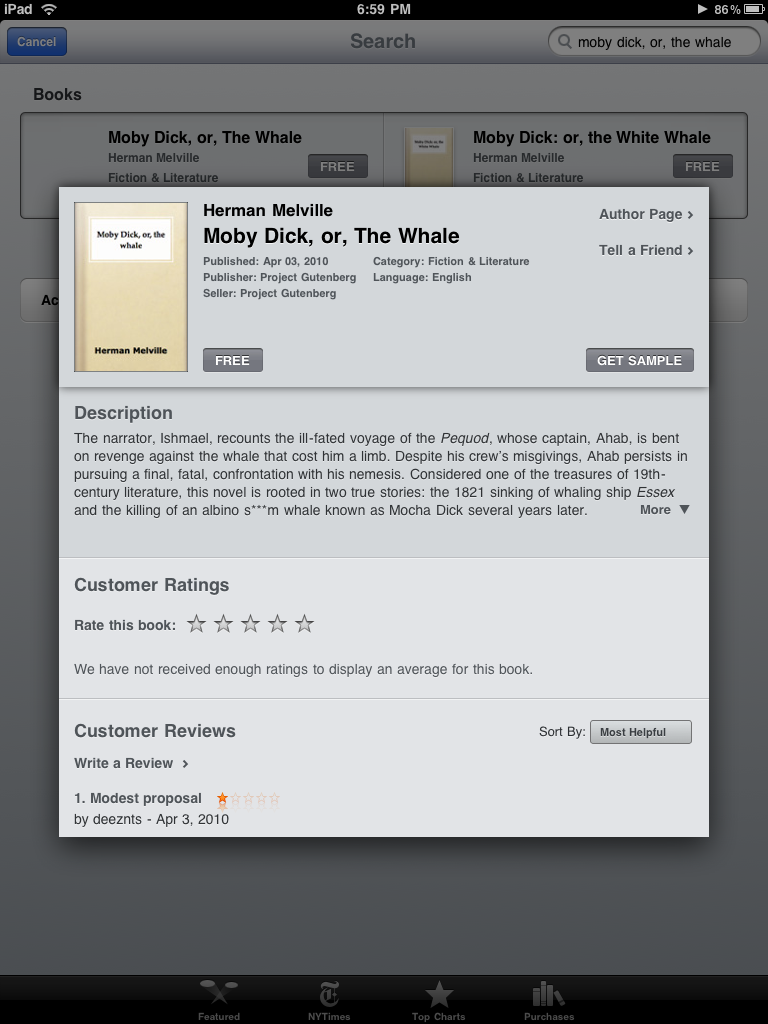
iBooks naughty word filter doesn't let you say "sperm"


IMG_0005thumb.png
Dean spotted that bowdlerization is afoot in the iPad's bookstore's selection of classic literature! This includes obvious candidates such as a certain Joseph Conrad classic.
But ... sperm?

Star Wars Sound Effects Quiz!

starwarsstormtroopersstefan.jpg
Photo: Stéfan Le Dû
We've isolated some distinctive--and not-so-distinctive!--audio snippets from the Star Wars flicks. Think you can identify them all? After you take the quiz, come on back and let us know how well you did. And if you have an idea for a future quiz, tell us your suggestion!

3D viewer + The Elements for iPad = stereoscopic scienceporn


3delements.jpg
ipad3d.jpgJust got my Loreo Pixi 3D viewer with which to view those element detail shots in Theodore Gray's The Elements for iPadin 3D. Verdict: takes a little getting used to, for my eyes anyway, but after a minute of perceptual adjustment it quickly turned into HOLYCRAPTHISISSOAWESOME. You know what America (heck, the world, but especially America) needs to combat anti-science sentiment, and the dumbing down of our kids? Elegant presentations of science. Interactive digital reference book/game/search/apps like this, that make learning tantalizing. Imagine if you'd first been exposed to the periodic table of elements like this as a kid! I say this with excitement for the iPad and content soon to be developed for that platform, but also with excitement for the new class of competing devices that sill surely follow.
Read my earlier review of The Elements here ($13.99 for iPad, Touchpress), and you canbuy the glasses here ($4.95 + S/H).

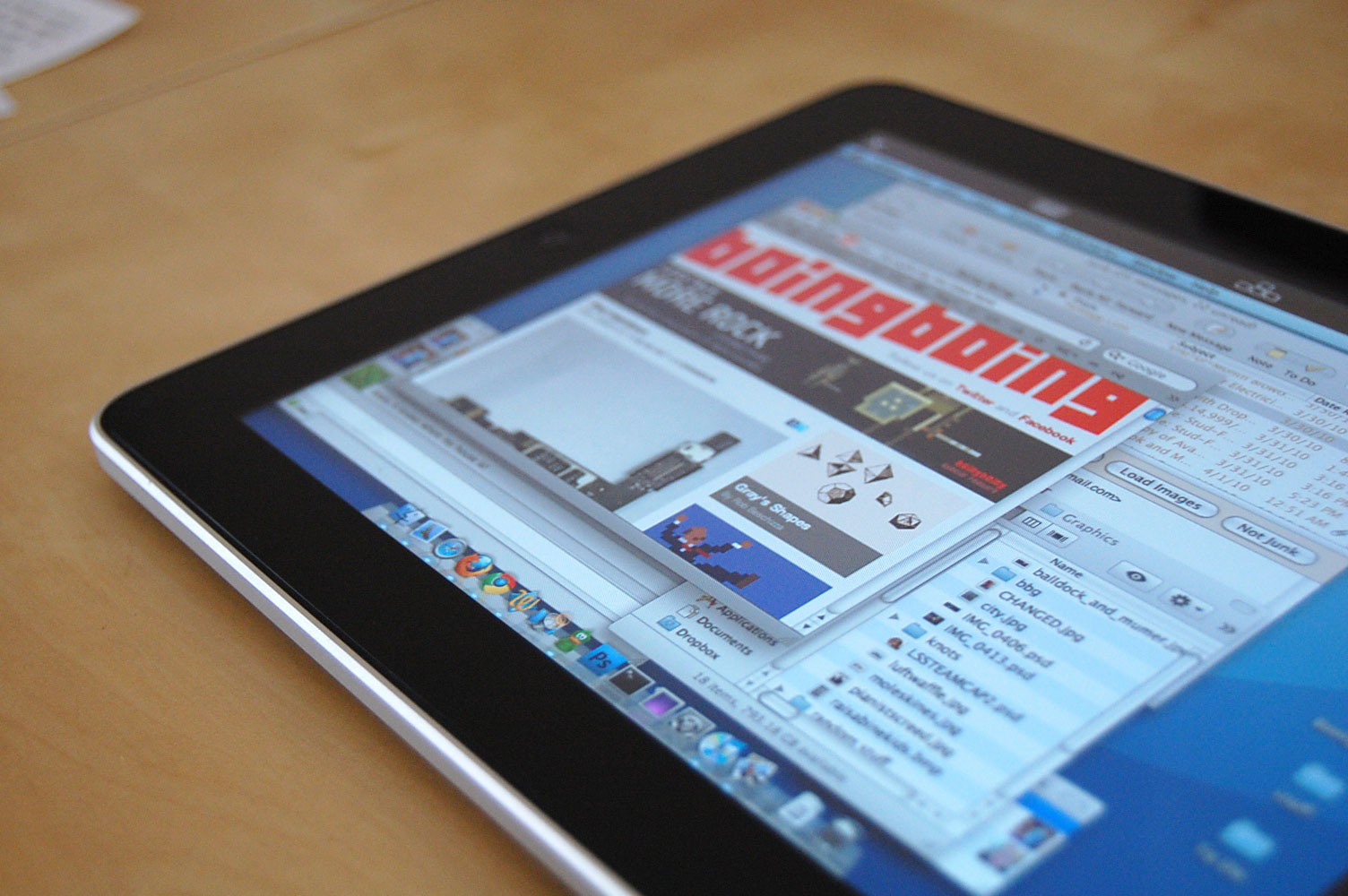
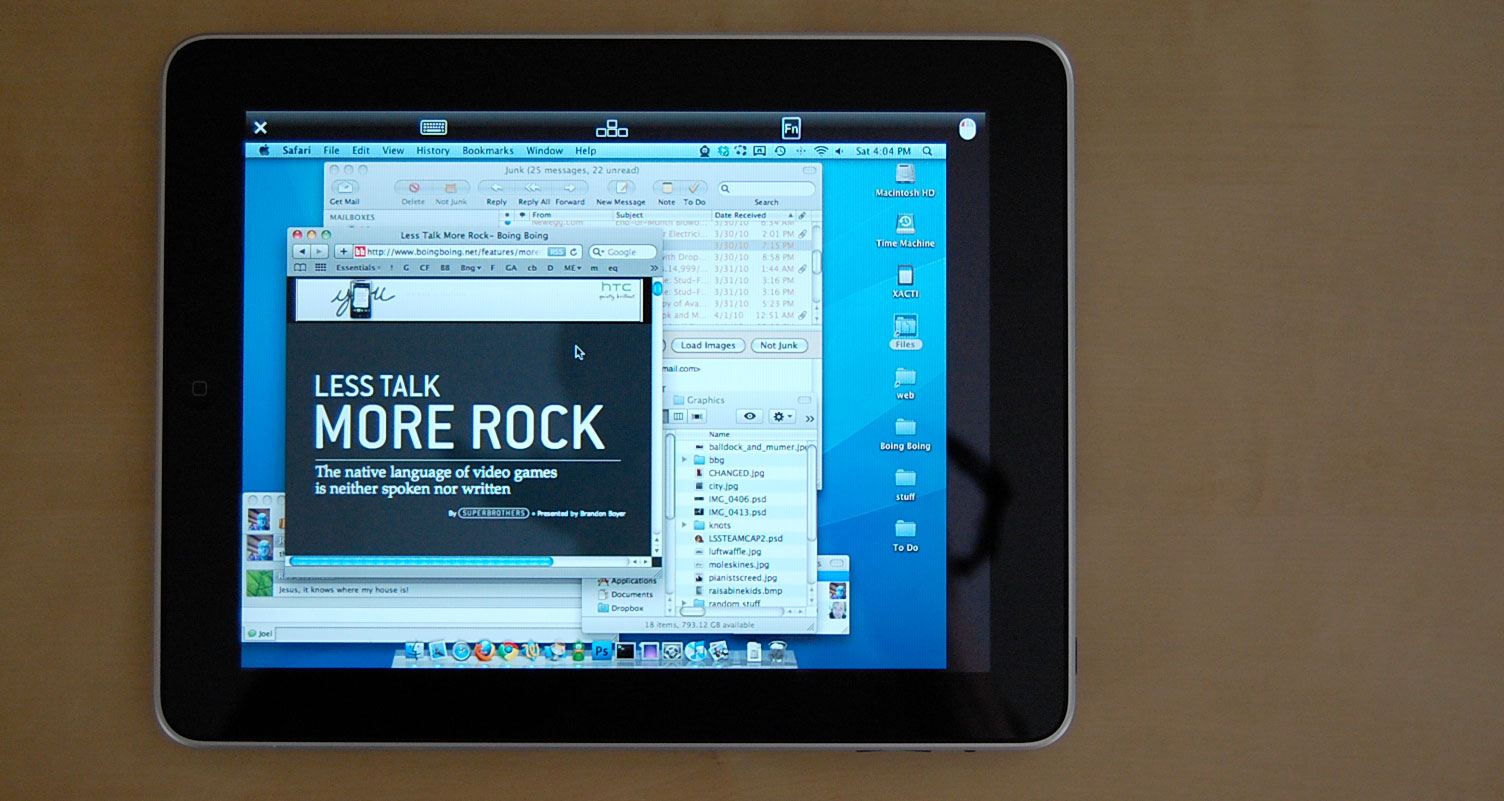
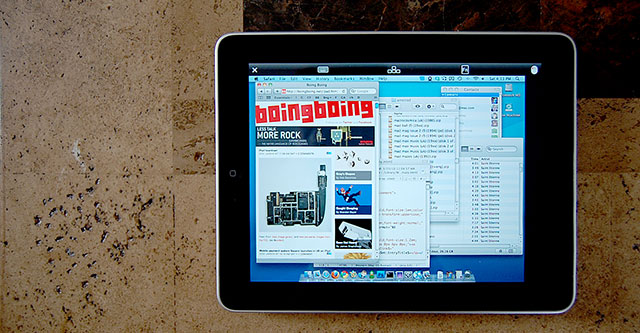
Behold! OSX on iPad! With Flash!


osx.jpg
Not really! It's actually Desktop Connect, a $12 app that lets you patch into other computers using VNC or RDP, two desktop-sharing protocols. It's neat to be able to lounge in bed and mess with a computer from afar--the iPad's sweet spot (or sour spot, for the detractors) between cellphone and laptop makes it great for turn-based games. Hip, urban server administrators will also be delighted.
osx0.jpg
Setup is easy, and a row of icons makes keyboard entry, including function keys,
straightforward. But there are some caveats: the touchscreen magic dissolves to frustration with desktop operating systems, even when you set the remote resolution to be the same as the iPad's. It's much easier to use the precise mousing mode.
osx1.jpg
iTunes link [via Gizmodo's John Hermann, who pulled the trick with a more Macolyte-horrifying choice of OS]

Giant iPad queue here in Pittsburgh

Unexpected, at least in Steel city! Many have no reservation.

Open source prosthetics

Clicking into an article by Aimee Mullins, a double below knee amputee, actress, track athlete, and total babe, resulted in a moment of groaning "what the hell" at my computer screen. The article -- "Is Choosing a Prosthesis so Different than Picking a Pair of Glasses?" -- spoke of how prosthetics have evolved to the point of being as specialized and aesthetically unique as eyeglasses in the last fifty years in the United States.
To illustrate her point, Mullins notes:
"...no one has yet to build a leg that does it all --- I have to change legs when I want to wear high heels; I have to change legs when I want to wear different height high heels; I have to change legs when I want to swim, take a boxing class at the gym, or sprint on the track. I have 12 pair in all (though many are housed in museums)."
While the there are indeed parallels, the article largely neglects the enormous burden of cost and limited access to this cutting-edge technology that so often gets featured in the press. Those very legs that Mullins has relegated to museums sit well out of financial reach for the majority of the disabled community.
Full disclosure: I myself am a double amputee; being born without legs. No stumps, femurs, or anything. I start at the pelvis. I never experienced the contrast of pre/post disability. I grew up thinking of myself as whole and complete. Whenever I was confronted with a set of legs, they felt like highly impractical stilts designed with aesthetics over function in mind.
I remember always feeling a mix of awkwardness and obligation when I slid into the big, wobbly, pair of legs. The only element that kept me in prosthetics was the reminder from doctors, family, and therapists of the time and money they took to create.
At every possible opportunity, I would abandon the legs in favor of running on my hands -- or later in life, using a skateboard. I found that the practicality and affordability of these two options allowed for more financial and logistic freedom for getting around the everyday world. If I was traveling and something on my skateboard broke, I could buy a replacement locally (and cheaply). If a glove got torn up on a hike, I could wrap some duct tape around it. My family had always focused on simple and practical solutions to any physical challenges I might face, and eventually I learned how to "MacGyver" my way out of situations as well.
I found out about www.openprosthetics.org in March, and immediately fell in love. NPR described the creator, Jonathan Kuniholm's mission, as an "open-source collaboration that makes its innovations available to anyone."
One of the most interesting examples was the reviving an old upper extremity prostheses that had been originally developed in the 1920s or '30s. Named the Trautman Hook, it consisted some rubber bands, three metal parts, and two screws. All of the designs were posted for free on the site, as well as fabrication costs from different companies around the country. A practical and cost-conscious alternative to the expensive and single function prosthetic paradigm felt like a revelation. Open Source. Some weird, cool concept that only futurists could write about. The Firefox of artificial limbs.
For a bit more perspective on the cost and difficulties of obtaining a prosthesis, I rang up Cliff Creekmore, the manager of a local Hanger Prosthetics branch in Montana.
"As of July of 2008, a moderate activity prosthesis for a below-the-knee amputee costs about $17,500."
For a double amputee, the expense doubles. And getting insurance to cover more than one leg is a hassle. When you put those costs in context of Aimee Mullins quote, from a financial perspective, buying a prosthesis is a world apart from buying glasses.
Thankfully, Aimee does go so far as to admit the issues confronted by the average prosthetic user, "Not one pair of my legs is covered by insurance; not one pair of my legs is considered "medically necessary."
And so, in the face of such debilitating costs and access to the prosthetics, it's incredibly liberating to see movements like The Open Prosthetics Project gaining momentum. Could it ever grow large enough to become an alternative to the private routes? I don't know, but I dearly hope so. As we've seen in many other areas, open source competition tends to breed innovation from incumbents, It would be something to one day finally see prosthetics that are adaptable and multi-use without the steep costs we currently experience.
Check out their main site to see some of the finished projects.
And if you want to get into the nuts-and-bolts of developing projects, head to their Ning site.

Make a lap stand for the iPad

Lenore and Windell, that brilliant hacker couple who run Evil Mad Scientist Laboratories, have a complete how-to for making a foldable lap stand for the iPad.
Sure, that iPad's fun. But doesn't your arm get tired propping up one and a half pounds after an hour or two?
Yes, one thing that the iPad is definitely missing is angle. A laptop has an adjustable screen, and you can just set it on your lap for couchborne surfing. Just set the iPad on your lap and... well... it's sits there taunting you, pointing at the ceiling.
You can try sitting cross-legged like Steve Jobs, angle your knees with the help of the coffee table, or give up and shell out for a tabletop dock.
No, it's not the end of the world. But shouldn't fun new toys just be... fun? So here is our solution: a DIY adjustable-angle iPad stand for your lap. Inexpensive, cozy, and light. Designed for both portrait and landscape use, and ready to fold up for transport and storage. With a stand, you can use your 'Pad with zero, one, or two hands, and sit how you darn well please.

Rug made out of cigarette butts

Jesus Bubu Negron, a Puerto Rican artist, made this rug out of cigarette butts found on the streets. Definitely don't want to get too comfortable on this one.

Great story on legal battle over gene patents


You might have heard that a Federal court invalidated seven patents on BRCA1 and BRCA2, collectively known as "the breast cancer genes", earlier this week. It is, to quote our Vice President, a big fucking deal.
A couple of years ago, I wrote a story for MSN.com about women who were faced with the decision to be tested for faulty versions of those two genes. If tests showed the women had mutations that were likely to lead to breast cancer, the decisions became even more complicated. Everyone handled it differently, but they were all happy to have the choice. Unfortunately, that choice was very expensive, one expert told me, largely because Myriad Genetics owned patents on the naturally occurring genes and, effectively, had a monopoly on testing. The monopoly also meant women couldn't get a second opinion, so to speak, because there was only one lab doing the tests.
Patents like this are nothing new. But, according to United States District Court Judge Robert W. Sweet ...
the patents were "improperly granted" because they involved a "law of nature." He said that many critics of gene patents considered the idea that isolating a gene made it patentable "a 'lawyer's trick' that circumvents the prohibition on the direct patenting of the DNA in our bodies but which, in practice, reaches the same result."
That's from a fabulous story by New York Times' reporters John Schwartz and Andrew Pollack. If you want to understand what's at stake in this case, why Monday's decision was so unexpected and what's up with the legal history on gene patents, this story is a great jumping-off point.

Making chemicals kosher

In the world of processed foods, keeping kosher is a complicated process that can involve individually certifying as many as 100 chemical compounds just to make a single flavoring agent that meets kosher standards.
The problem is where the compounds come from. In the 1930s, Atlanta-area Rabbi Tobias Geffen was asked to help make Coca-Cola kosher. In the process, he realized that glycerin, a chemical additive used to disperse flavors evenly through the soda, was made from rendered animal fat—and there was no clear way to tell whether the fat came from a kosher animal. Geffen decided that even the molecules mattered. Coca-Cola made their kosher brew with cotton-seed oil glycerin instead, and other rabbis have followed Geffen's lead.
Today, you can spot kosher-for-Passover soda by the distinctive yellow cap. In this case, sucrose subs in as the sweetener, in place of corn syrup, as corn is a banned grain during the Passover holiday.

Taste Test: Buddha's Hand

This has to be one of the strangest looking fruits that you can buy at the supermarket. It's also one of the most useless when it comes to conventional usage — this member of the citrus family has no pulp or juices; it's all skin and pith. But while you wouldn't squeeze this one over veggies or in your afternoon tea, its rind is a complement to almost anything and can be seen on many a fancy restaurant's menu.
Buddha's Hand hails from India and parts of China. It may have gotten its name from the way it looks like human fingers, or because it's sometimes used as an offering at Buddhist temples. In parts of Asia, it's used to decorate tabletops and as a natural air freshener. Here in the US, you may have experienced it as flavored vodka.
Instructables.com has a quick and easy recipe for candied Buddha's Hand. Here are the basics:
Chop up 1 Buddha's Hand into small strips or cubes. Put them in a pot with 3 cups of water and 3 cups of sugar, and bring to a boil on medium heat. Once it boils, simmer for 45 minutes. Once it becomes candied and syrupy, turn off the heat and let it cool for about a half hour.
I should mention that this fruit is not in season right now; you might be able to find it at the supermarket now, but you'll likely have to wait until fall, which is when it's most ready to eat.
Every installment of Taste Test will explore recipes, the science, and some history behind a specific food item.

Exploded propellorized truncated wooden icosahedron

Sculptor George W. Hart creates geometric forms in wood; remarkable is just one word for it.
"My work deals with patterns and relationships derived from classical ideals of balance and symmetry, " Hart writes at his website. "Mathematical yet organic, these abstract forms invite the viewer to partake of the geometric aesthetic. ... Classical forms are pushed in new directions, so viewers can take pleasure in their Platonic beauty yet recognize how they are updated for our complex high-tech times."
Pictured here is Roads Untaken, made of 902 individual pieces of wood.

Why I won't buy an iPad (and think you shouldn't, either)


I've spent ten years now on Boing Boing, finding cool things that people have done and made and writing about them. Most of the really exciting stuff hasn't come from big corporations with enormous budgets, it's come from experimentalist amateurs. These people were able to make stuff and put it in the public's eye and even sell it without having to submit to the whims of a single company that had declared itself gatekeeper for your phone and other personal technology.
Danny O'Brien does a very good job of explainingwhy I'm completely uninterested in buying an iPad -- it really feels like the second coming of the CD-ROM "revolution" in which "content" people proclaimed that they were going to remake media by producing expensive (to make and to buy) products. I was a CD-ROM programmer at the start of my tech career, and I felt that excitement, too, and lived through it to see how wrong I was, how open platforms and experimental amateurs would eventually beat out the spendy, slick pros.
I remember the early days of the web -- and the last days of CD ROM -- when there was this mainstream consensus that the web and PCs were too durned geeky and difficult and unpredictable for "my mom" (it's amazing how many tech people have an incredibly low opinion of their mothers). If I had a share of AOL for every time someone told me that the web would die because AOL was so easy and the web was full of garbage, I'd have a lot of AOL shares.
And they wouldn't be worth much.
Incumbents made bad revolutionaries
Relying on incumbents to produce your revolutions is not a good strategy. They're apt to take all the stuff that makes their products great and try to use technology to charge you extra for it, or prohibit it altogether.
I mean, look at that Marvel app (just look at it). I was a comic-book kid, and I'm a comic-book grownup, and the thing that made comics for me was sharing them. If there was ever a medium that relied on kids swapping their purchases around to build an audience, it was comics. And the used market for comics! It was -- and is -- huge, and vital. I can't even count how many times I've gone spelunking in the used comic-bins at a great and musty store to find back issues that I'd missed, or sample new titles on the cheap. (It's part of a multigenerational tradition in my family -- my mom's father used to take her and her sibs down to Dragon Lady Comics on Queen Street in Toronto every weekend to swap their old comics for credit and get new ones).
So what does Marvel do to "enhance" its comics? They take away the right to give, sell or loan your comics. What an improvement. Way to take the joyous, marvellous sharing and bonding experience of comic reading and turn it into a passive, lonely undertaking that isolates, rather than unites. Nice one, Misney.
Infantalizing hardware
Then there's the device itself: clearly there's a lot of thoughtfulness and smarts that went into the design. But there's also a palpable contempt for the owner. I believe -- really believe -- in the stirring words of the Maker Manifesto: if you can't open it, you don't own it. Screws not glue. The original Apple ][+ came with schematics for the circuit boards, and birthed a generation of hardware and software hackers who upended the world for the better. If you wanted your kid to grow up to be a confident, entrepreneurial, and firmly in the camp that believes that you should forever be rearranging the world to make it better, you bought her an Apple ][+.
But with the iPad, it seems like Apple's model customer is that same stupid stereotype of a technophobic, timid, scatterbrained mother as appears in a billion renditions of "that's too complicated for my mom" (listen to the pundits extol the virtues of the iPad and time how long it takes for them to explain that here, finally, is something that isn't too complicated for their poor old mothers).
The model of interaction with the iPad is to be a "consumer," what William Gibson memorably described as "something the size of a baby hippo, the color of a week-old boiled potato, that lives by itself, in the dark, in a double-wide on the outskirts of Topeka. It's covered with eyes and it sweats constantly. The sweat runs into those eyes and makes them sting. It has no mouth... no genitals, and can only express its mute extremes of murderous rage and infantile desire by changing the channels on a universal remote."
The way you improve your iPad isn't to figure out how it works and making it better. The way you improve the iPad is to buy iApps. Buying an iPad for your kids isn't a means of jump-starting the realization that the world is yours to take apart and reassemble; it's a way of telling your offspring that even changing the batteries is something you have to leave to the professionals.
Dale Dougherty's piece on Hypercard and its influence on a generation of young hackers is a must-read on this. I got my start as a Hypercard programmer, and it was Hypercard's gentle and intuitive introduction to the idea of remaking the world that made me consider a career in computers.
Wal-Martization of the software channel
And let's look at the iStore. For a company whose CEO professes a hatred of DRM, Apple sure has made DRM its alpha and omega. Having gotten into business with the two industries that most believe that you shouldn't be able to modify your hardware, load your own software on it, write software for it, override instructions given to it by the mothership (the entertainment industry and the phone companies), Apple has defined its business around these principles. It uses DRM to control what can run on your devices, which means that Apple's customers can't take their "iContent" with them to competing devices, and Apple developers can't sell on their own terms.
The iStore lock-in doesn't make life better for Apple's customers or Apple's developers. As an adult, I want to be able to choose whose stuff I buy and whom I trust to evaluate that stuff. I don't want my universe of apps constrained to the stuff that the Cupertino Politburo decides to allow for its platform. And as a copyright holder and creator, I don't want a single, Wal-Mart-like channel that controls access to my audience and dictates what is and is not acceptable material for me to create. The last time I posted about this, we got a string of apologies for Apple's abusive contractual terms for developers, but the best one was, "Did you think that access to a platform where you can make a fortune would come without strings attached?" I read it in Don Corleone's voice and it sounded just right. Of course I believe in a market where competition can take place without bending my knee to a company that has erected a drawbridge between me and my customers!
Journalism is looking for a daddy figure
I think that the press has been all over the iPad because Apple puts on a good show, and because everyone in journalism-land is looking for a daddy figure who'll promise them that their audience will go back to paying for their stuff. The reason people have stopped paying for a lot of "content" isn't just that they can get it for free, though: it's that they can get lots of competing stuff for free, too. The open platform has allowed for an explosion of new material, some of it rough-hewn, some of it slick as the pros, most of it targetted more narrowly than the old media ever managed. Rupert Murdoch can rattle his saber all he likes about taking his content out of Google, but I say do it, Rupert. We'll miss your fraction of a fraction of a fraction of a percent of the Web so little that we'll hardly notice it, and we'll have no trouble finding material to fill the void.
Just like the gadget press is full of devices that gadget bloggers need (and that no one else cares about), the mainstream press is full of stories that affirm the internal media consensus. Yesterday's empires do something sacred and vital and most of all grown up, and that other adults will eventually come along to move us all away from the kids' playground that is the wild web, with its amateur content and lack of proprietary channels where exclusive deals can be made. We'll move back into the walled gardens that best return shareholder value to the investors who haven't updated their portfolios since before eTrade came online.
But the real economics of iPad publishing tell a different story: even a stellar iPad sales performance isn't going to do much to staunch the bleeding from traditional publishing. Wishful thinking and a nostalgia for the good old days of lockdown won't bring customers back through the door.
Gadgets come and gadgets go
Gadgets come and gadgets go. The iPad you buy today will be e-waste in a year or two (less, if you decide not to pay to have the battery changed for you). The real issue isn't the capabilities of the piece of plastic you unwrap today, but the technical and social infrastructure that accompanies it.
If you want to live in the creative universe where anyone with a cool idea can make it and give it to you to run on your hardware, the iPad isn't for you.
If you want to live in the fair world where you get to keep (or give away) the stuff you buy, the iPad isn't for you.
If you want to write code for a platform where the only thing that determines whether you're going to succeed with it is whether your audience loves it, the iPad isn't for you.